 Add to Chrome
 Add to Firefox
 Add to Edge
Non-Forgetting Knowledge Allocation with Bi-level Competition for Class-Incremental Learning
May 28, 2026
Class-Incremental Learning (CIL) with pre-trained models (PTMs) aims to sequentially adapt PTMs to new categories without forgetting old knowledge. Built upon PTMs, existing adapter-based methods mainly train models via distinct task-specific adapters, and present a uniform knowledge allocation for each adapter during inference. However, this allocation mechanism ignores the nature of task discrepancy and leads to suboptimal utilization of adapters. Also, under CIL constraint, an allocator is prone to forgetting when tasks evolve. To address these issues, we propose a Non-Forgetting Allocation with Bi-Level Competition (NoFA-BC). NoFA-BC constructs a non-forgetting allocator (NFA) by transforming the allocator training into a recursive least-squares problem and achieves an allocator equivalent to that trained with all data. Based on the NFA, a Bi-Level Competition (BLC) including an intra-task level Winner-Takes-All (WTA) mechanism and inter-task Last-Ones-Fall (LOF) elimination is proposed to provide better allocation of adapter knowledge. WTA extracts the most significant logit within a task to represent the adapter's contribution and LOF suppresses the irrelevant adapters. With BLC, participation ratio of each adapter can be tailored for each input. Moreover, a Stability Enhancement (SE) process is incorporated to further improve the performance of old tasks.

StepAudio 2.5 Technical Report
May 22, 2026Unified audio-language modeling has emerged as a prominent trend in modern speech systems, promising to bring the reasoning capabilities of large language models to auditory tasks. However, existing unified foundations often struggle to match the depth of specialized systems across automatic speech recognition (ASR), text-to-speech synthesis (TTS), and realtime spoken interaction. Bridging this gap remains an open challenge. This report presents StepAudio 2.5, a unified audio-language foundation model that matches or exceeds specialized systems across all three capabilities. Rather than treating these tasks as architecturally distinct, we operate on the premise that once text and audio share a multimodal representational space, task specialization becomes a matter of operational regimes: data construction, optimization targets, and decoding constraints. Guided by this insight, we advance the post-training paradigm from standard supervised learning to task-tailored Reinforcement Learning from Human Feedback (RLHF), using it as the primary mechanism to define complex optimization targets. We leverage this RLHF-centric alignment, alongside specialized decoding, to shape a shared backbone into three distinct operational modes. Concretely, the ASR branch advances transcription efficiency via verifiable multi-token decoding; the TTS branch achieves controllable, expressive synthesis through preference-based RLHF and context-rich supervision; and the Realtime branch realizes low-latency, persona-consistent dialogue via generative reward modeling within an RLHF framework. On standard benchmarks, StepAudio 2.5 achieves state-of-the-art results across ASR, TTS, and Realtime, demonstrating that a singular audio-language foundation can successfully internalize the distinct deployment objectives of speech understanding, generation, and live interaction.
PRiMeFlow: Capturing Complex Expression Heterogeneity in Perturbation Response Modelling
Apr 15, 2026Predicting the effects of perturbations in-silico on cell state can identify drivers of cell behavior at scale and accelerate drug discovery. However, modeling challenges remain due to the inherent heterogeneity of single cell gene expression and the complex, latent gene dependencies. Here, we present PRiMeFlow, an end-to-end flow matching based approach to directly model the effects of genetic and small molecule perturbations in the gene expression space. The distribution-fitting approach taken by PRiMeFlow enables it to accurately approximate the empirical distribution of single-cell gene expression, which we demonstrate through extensive benchmarking inside PerturBench. Through ablation studies, we also validate important model design choices such as operating in gene expression space and parameterizing the velocity field with a U-Net architecture. The PRiMeFlow architecture was used as the basis for the model that won the Generalist Prize in the first ARC Virtual Cell Challenge.
Semantic-Contact Fields for Category-Level Generalizable Tactile Tool Manipulation
Feb 14, 2026Generalizing tool manipulation requires both semantic planning and precise physical control. Modern generalist robot policies, such as Vision-Language-Action (VLA) models, often lack the high-fidelity physical grounding required for contact-rich tool manipulation. Conversely, existing contact-aware policies that leverage tactile or haptic sensing are typically instance-specific and fail to generalize across diverse tool geometries. Bridging this gap requires learning unified contact representations from diverse data, yet a fundamental barrier remains: diverse real-world tactile data are prohibitive at scale, while direct zero-shot sim-to-real transfer is challenging due to the complex dynamics of nonlinear deformation of soft sensors. To address this, we propose Semantic-Contact Fields (SCFields), a unified 3D representation fusing visual semantics with dense contact estimates. We enable this via a two-stage Sim-to-Real Contact Learning Pipeline: first, we pre-train on a large simulation data set to learn general contact physics; second, we fine-tune on a small set of real data, pseudo-labeled via geometric heuristics and force optimization, to align sensor characteristics. This allows physical generalization to unseen tools. We leverage SCFields as the dense observation input for a diffusion policy to enable robust execution of contact-rich tool manipulation tasks. Experiments on scraping, crayon drawing, and peeling demonstrate robust category-level generalization, significantly outperforming vision-only and raw-tactile baselines.
Clinical NLP with Attention-Based Deep Learning for Multi-Disease Prediction
Jul 02, 2025This paper addresses the challenges posed by the unstructured nature and high-dimensional semantic complexity of electronic health record texts. A deep learning method based on attention mechanisms is proposed to achieve unified modeling for information extraction and multi-label disease prediction. The study is conducted on the MIMIC-IV dataset. A Transformer-based architecture is used to perform representation learning over clinical text. Multi-layer self-attention mechanisms are employed to capture key medical entities and their contextual relationships. A Sigmoid-based multi-label classifier is then applied to predict multiple disease labels. The model incorporates a context-aware semantic alignment mechanism, enhancing its representational capacity in typical medical scenarios such as label co-occurrence and sparse information. To comprehensively evaluate model performance, a series of experiments were conducted, including baseline comparisons, hyperparameter sensitivity analysis, data perturbation studies, and noise injection tests. Results demonstrate that the proposed method consistently outperforms representative existing approaches across multiple performance metrics. The model maintains strong generalization under varying data scales, interference levels, and model depth configurations. The framework developed in this study offers an efficient algorithmic foundation for processing real-world clinical texts and presents practical significance for multi-label medical text modeling tasks.
Seed1.5-VL Technical Report
May 11, 2025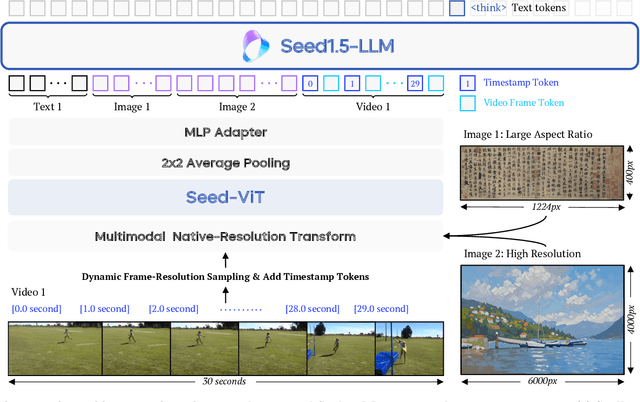

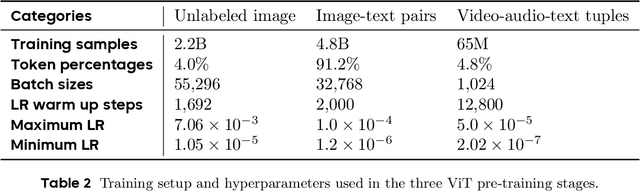
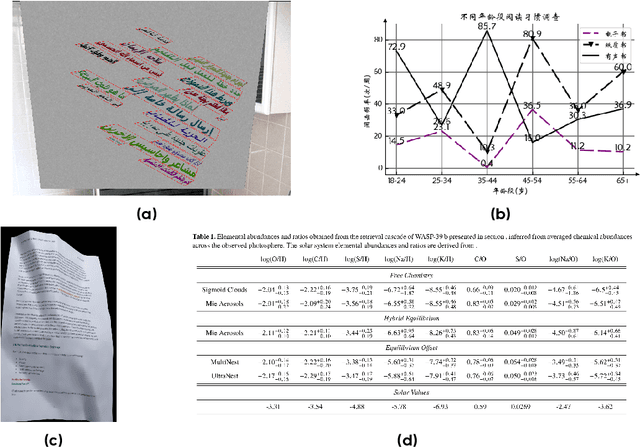
We present Seed1.5-VL, a vision-language foundation model designed to advance general-purpose multimodal understanding and reasoning. Seed1.5-VL is composed with a 532M-parameter vision encoder and a Mixture-of-Experts (MoE) LLM of 20B active parameters. Despite its relatively compact architecture, it delivers strong performance across a wide spectrum of public VLM benchmarks and internal evaluation suites, achieving the state-of-the-art performance on 38 out of 60 public benchmarks. Moreover, in agent-centric tasks such as GUI control and gameplay, Seed1.5-VL outperforms leading multimodal systems, including OpenAI CUA and Claude 3.7. Beyond visual and video understanding, it also demonstrates strong reasoning abilities, making it particularly effective for multimodal reasoning challenges such as visual puzzles. We believe these capabilities will empower broader applications across diverse tasks. In this report, we mainly provide a comprehensive review of our experiences in building Seed1.5-VL across model design, data construction, and training at various stages, hoping that this report can inspire further research. Seed1.5-VL is now accessible at https://www.volcengine.com/ (Volcano Engine Model ID: doubao-1-5-thinking-vision-pro-250428)
Fast2comm:Collaborative perception combined with prior knowledge
Apr 30, 2025Collaborative perception has the potential to significantly enhance perceptual accuracy through the sharing of complementary information among agents. However, real-world collaborative perception faces persistent challenges, particularly in balancing perception performance and bandwidth limitations, as well as coping with localization errors. To address these challenges, we propose Fast2comm, a prior knowledge-based collaborative perception framework. Specifically, (1)we propose a prior-supervised confidence feature generation method, that effectively distinguishes foreground from background by producing highly discriminative confidence features; (2)we propose GT Bounding Box-based spatial prior feature selection strategy to ensure that only the most informative prior-knowledge features are selected and shared, thereby minimizing background noise and optimizing bandwidth efficiency while enhancing adaptability to localization inaccuracies; (3)we decouple the feature fusion strategies between model training and testing phases, enabling dynamic bandwidth adaptation. To comprehensively validate our framework, we conduct extensive experiments on both real-world and simulated datasets. The results demonstrate the superior performance of our model and highlight the necessity of the proposed methods. Our code is available at https://github.com/Zhangzhengbin-TJ/Fast2comm.
UniPhys: Unified Planner and Controller with Diffusion for Flexible Physics-Based Character Control
Apr 17, 2025Generating natural and physically plausible character motion remains challenging, particularly for long-horizon control with diverse guidance signals. While prior work combines high-level diffusion-based motion planners with low-level physics controllers, these systems suffer from domain gaps that degrade motion quality and require task-specific fine-tuning. To tackle this problem, we introduce UniPhys, a diffusion-based behavior cloning framework that unifies motion planning and control into a single model. UniPhys enables flexible, expressive character motion conditioned on multi-modal inputs such as text, trajectories, and goals. To address accumulated prediction errors over long sequences, UniPhys is trained with the Diffusion Forcing paradigm, learning to denoise noisy motion histories and handle discrepancies introduced by the physics simulator. This design allows UniPhys to robustly generate physically plausible, long-horizon motions. Through guided sampling, UniPhys generalizes to a wide range of control signals, including unseen ones, without requiring task-specific fine-tuning. Experiments show that UniPhys outperforms prior methods in motion naturalness, generalization, and robustness across diverse control tasks.
Physics-Aware Initialization Refinement in Code-Aided EM for Blind Channel Estimation
Apr 15, 2025This paper addresses the well-known local maximum problem of the expectation-maximization (EM) algorithm in blind intersymbol interference (ISI) channel estimation. This problem primarily results from phase and shift ambiguity during initialization, which blind estimation is inherently unable to distinguish. We propose an effective initialization refinement algorithm that utilizes the decoder output as a model selection metric, incorporating a technique to detect phase and shift ambiguity. Our results show that the proposed algorithm significantly reduces the number of local maximum cases to nearly one-third for a 3-tap ISI channel under highly uncertain initial conditions. The improvement becomes more pronounced as initial errors increase and the channel memory grows. When used in a turbo equalizer, the proposed algorithm is required only in the first turbo iteration, which limits any complexity increase with subsequent iterations.
Modified Baum-Welch Algorithm for Joint Blind Channel Estimation and Turbo Equalization
Dec 10, 2024
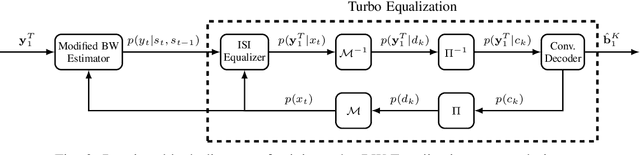
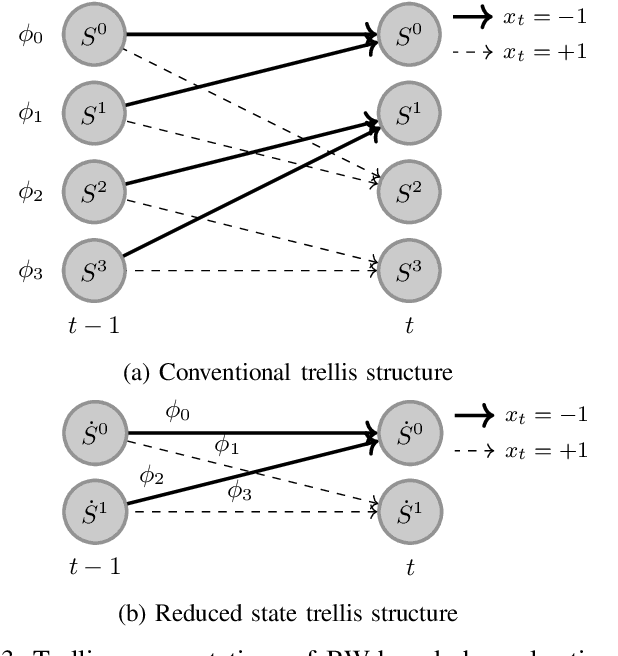
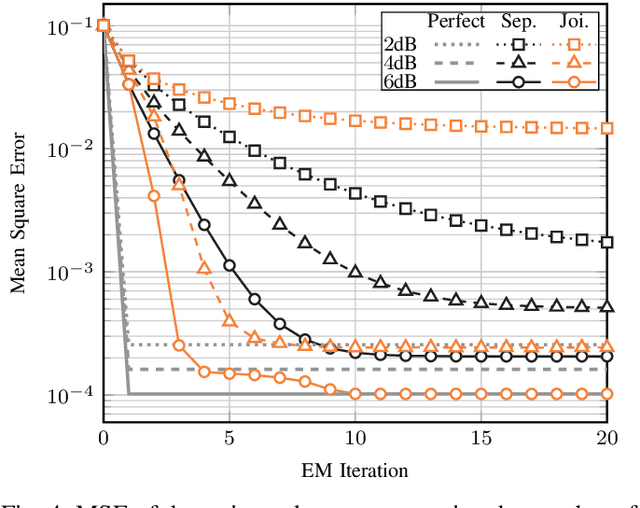
Blind estimation of intersymbol interference channels based on the Baum-Welch (BW) algorithm, a specific implementation of the expectation-maximization (EM) algorithm for training hidden Markov models, is robust and does not require labeled data. However, it is known for its extensive computation cost, slow convergence, and frequently converges to a local maximum. In this paper, we modified the trellis structure of the BW algorithm by associating the channel parameters with two consecutive states. This modification enables us to reduce the number of required states by half while maintaining the same performance. Moreover, to improve the convergence rate and the estimation performance, we construct a joint turbo-BW-equalization system by exploiting the extrinsic information produced by the turbo decoder to refine the BW-based estimator at each EM iteration. Our experiments demonstrate that the joint system achieves convergence in just 4 EM iterations, which is 8 iterations less than a separate system design for a signal-to-noise ratio (SNR) of 6 dB. Additionally, the joint system provides improved estimation accuracy with a mean square error (MSE) of $10^{-4}$. We also identify scenarios where a joint design is not preferable, especially when the channel is noisy (e.g., SNR=2 dB) and the turbo decoder is unable to provide reliable extrinsic information for a BW-based estimator.